



Our Baking Process
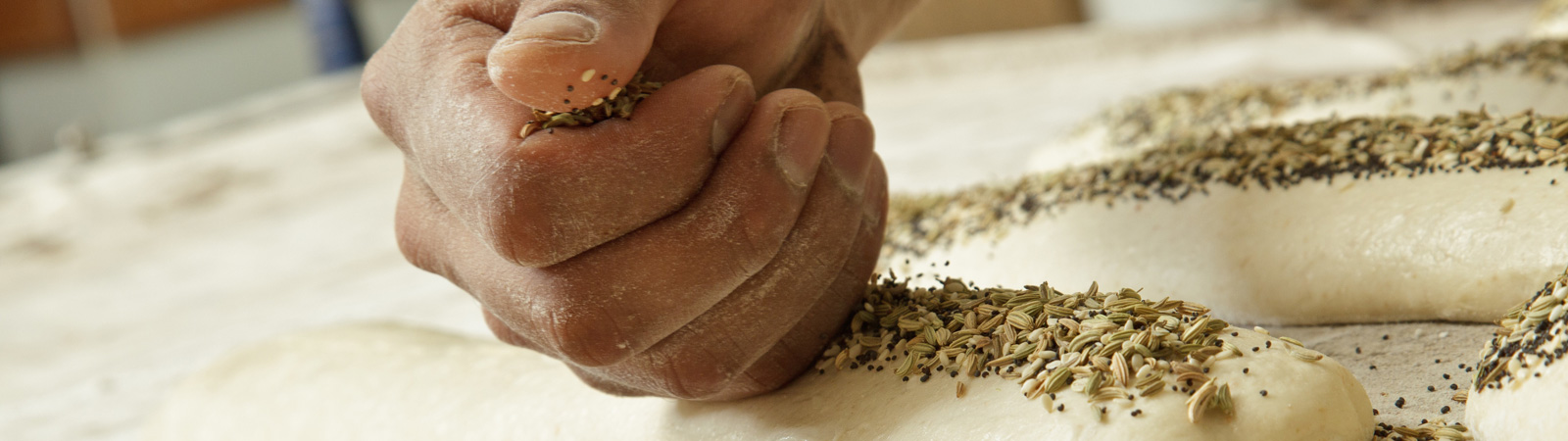
We bake everything from scratch everyday and use the age-old method of long fermentation when crafting our signature breads and viennoiserie. This means that after mixing the dough, we let it sit for hours (or even days!) at a controlled temperature to develop flavor and strength. The complexity of the flavor of our bread and the texture achieved through our slow fermentation process are what set us apart from other bakeries. More on this process below. . .
Ingredients: Nothing But the Best (& NO preservatives)
We Mill All Our Whole Grain Flour!
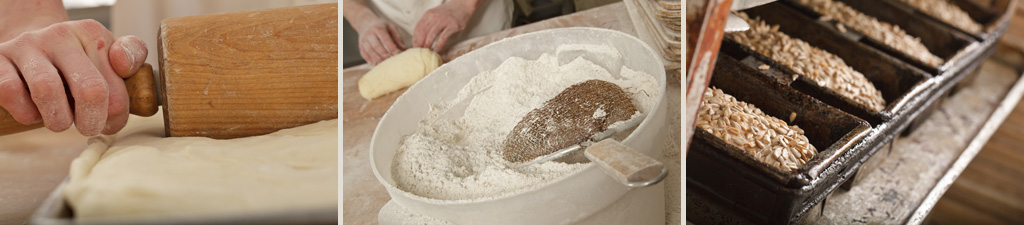
Baking with freshly milled flour is a game changer! The flavor, aroma, texture and even nutritional value achieved is unparalleled. We began milling whole grains in 2014 with the purchase of our first stone mill, an Austrian Osttiroler. Currently, we mill over 300 pounds of organically grown grain each day on our stone mill hand crafted by Andrew Heyn of New American Stone Mills. We have worked hard over the last several years to successfully source all of our whole grains from the Northeast (primarily through Maine Grains) and are so proud to support these smaller farms and mills! Not only do we know where our flour and grain are coming from, but we can stand in their fields or mills in just a day’s drive. When grain is stone milled, the entire grain passes over the stone and is retained in the flour – thus creating whole grain flour (ie: whole wheat or whole rye). The flour we are milling is so much finer that anything available commercially, and our bakers love the quality and flavor that the flours lend to our breads. We currently mill all of the whole wheat, rye, spelt and corn used in our breads and pastries. That’s a lot of fresh flour every day!
All Purpose Flour
Along with our house-milled whole grain flour, we use low protein, unbleached, all purpose flour (milled with wheat from farms that practice organic farming) – never “high gluten” or “bread” flour. Long fermentation strengthens our bread dough, creates flavor, and allows us to accomplish the open hole structure we strive for. Strong, “high gluten” flours are best reserved for bagels or short fermented doughs that rely on other ingredients for flavor. Any of our breads with “stuff” in them such as olives, cheddar cheese or nuts could stand on their own as a delicious tasting bread.
Other Ingredients
Our breads, pastries and other baked goods are made with the finest all natural ingredients and never with preservatives. We use only the highest quality, high butterfat butter. It costs so much more, but trust us – it really makes a difference! We source locally as much as possible including fresh brown eggs from Stamp Farms in Johnston, Rhode Island and milk from Wrights Dairy Farm in Smithfield, Rhode Island. We take an incredible amount of care in selecting every ingredient we bake with.
Pre-fermentation: Let’s Start at the Very Beginning
A pre-ferment can be sourdough based (levain) or made with fresh yeast.. It’s a dough that can be stiff, liquid or anywhere in between. We use 6 different types of pre-ferments: a stiff levain, a whole rye levain, a liquid levain for our croissants, whole wheat levain, a liquid Poolish and a stiff, yeasted Italian style starter called a Biga. All of our breads contain at least one, if not two pre-ferments. The main job of a pre-ferment is to jump start the long fermentation process. It gives a tremendous amount of flavor and texture, extends shelf life and adds depth and character to our breads and viennoiserie.
Our sourdough starters began life on the front shelf of our old Llopis brick oven at our Hope Street store several months before opening the bakery in 2001! Keeping a sourdough starter young and healthy, through a series of “builds” or “refreshments,” creates complexity and strength without an overbearing tang in the finished loaf. This creates a balanced level of bacteria for flavor and natural yeast for fermentation.
In contrast to the sourdough, which has been kept healthy and active for years, a yeasted pre-ferment is created daily by mixing a very small amount of fresh yeast into water and flour. Our Biga and Poolish are allowed to ferment for up to 20 hours before being used in our yeasted breads (Durum and Baguettes). By using a yeasted pre-ferment, we are able to cut back the total amount of yeast dramatically, creating a more natural, long fermentation, which adds depth of flavor without the acidity found in sourdough bread.
Many customers have commented over the years that our sourdough based bread is not actually sour, but has a tremendous amount of flavor. This is not by accident! In fact, many French bakers consider excessively sour bread a defect. We keep our sourdough starters young and healthy so they are ready to raise the bread and contribute flavor and texture. We prefer to pull maximum flavor out of the wheat and provide a slight tang that compliments the bread and the other food at the table, rather than overwhelm the palate with sharp sourness.
Bread
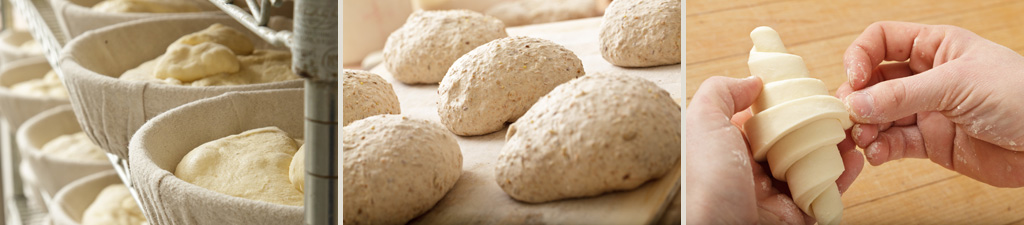
All of our breads are made with four basic ingredients: flour, water, salt and sourdough starter or yeast. To those ingredients we may add nuts, raisins, cheese, olives—but never preservatives. The fermentation and the unusually high hydration of our doughs help act as a natural preservative to extend the shelf life.
The production method itself is more a process than a recipe. Our “recipes” change with time, raw ingredients and to a certain extent, the seasons. Our bakery is temperature controlled from the time dough is mixed until it goes into the oven, but seasonal variations such as humidity and what actually happens in the fields with a grain of wheat can have a significant impact. This is the true skill of the baker: adjusting time and temperature in light of seasonal changes and manipulating the raw ingredients to produce the same delicious bread or croissant day after day.
Viennoiserie
The dough for our croissants and danish have lengthy fermentation schedules that are comparable to a loaf of bread. We then use a process called lamination to literally fold butter into the slightly sweet, rich, fermented dough. The chilled butter is encased in the dough and repetitively rolled out and folded onto itself until there are many distinct layers of butter and dough. In between folds, the dough is given a chance to rest. When the dough is finally shaped, proofed and put in the oven, steam is created from the many layers of butter trapped in the dough which creates the layers of light flaky pastry that we love. If the pastry is not flaking all over your lap, we either did something wrong, or it’s a very humid day! Unlike a lot of croissants and danish on the market, we are not looking to create an overly sweet, decadent morning pastry. Our time honored fermentation process actually allows us to cut the normal amount of butter back in our croissants from what you may typically find in others. This is not to say that a Seven Stars Bakery croissant is low fat. It still contains 1/3 of its volume in butter! After all, that is what a croissant is all about—the butter!
Scones, Muffins, Cookies…
Our talented and dedicated pastry team handcrafts everything from scratch daily. That’s what sets us apart. Well, that and the butter! (Did we mention we only use high butterfat butter?!) Our recipes have a long ingredient list of things you would know like flour, eggs, butter, pure vanilla, nuts (always toasted to bring out all the flavor), ginger, chocolate, salt, brown sugar…. We don’t use any ingredients with scientific sounding names that you’ve never heard before. We make things the way they used to be made, and the results speak for themselves.
Yes, it’s true, it may not be “healthy,” and we will likely never create a “low fat” line. That’s just not what we do. However, everything we offer is real, and in moderation can be considered acceptable in a well rounded diet. Every well rounded diet needs the occasional decadent Sticky Bun!